Nothing is so fatiguing as the eternal hanging on of an uncompleted task. ~William James
Showing posts with label ritual. Show all posts

Friday, August 20, 2010

The New Age Adventures of a Triathlete Newbie-in-Waiting


I came dangerously close to not blogging at all today.  (Wow!  We dodged that bullet, hey?)  


The day began at 2:30 a.m., and then again at 4:30, when I finally gave up and left my bed.  I had been invited by a Facebook friend to attend a Shamanic Healing Ceremony at dawn, but had decided not to set the alarm for it--not really thinking of myself as the Shamanic Healing Ceremony type.   But when I was up anyway, I thought, what the heck?  In keeping with my new "curiosity" theme, and having plenty of aspects of my life in need of healing--not the least of which is my continuing propensity to awaken several times a night with visions of, no, not sugarplums, but open water swim race starts "dancing" in my head, and in my nervous system--it seemed like the thing to do at that hour.


And as it turned out, it was actually a pretty cool experience.  For one, I got to be on this beautiful stretch of secluded beach, with the waves pounding in my tired ears, while a deep coral sun appeared through partial fog.  It's been too long since I've seen the sun come up.


For another, I had the privilege of being "smudged" with sage--a ritual to purify and cleanse one of negative influences.  The man leading the ceremony--a real, actual shaman--performed this rite for each of those present, with some variations apparently dictated by the kind of energy projected by each.  In my case, and only mine, he knelt before me in the sand for some time before continuing the smoke blessing.  When I asked him later what prompted him to do that, he took some time in answering that he "felt a sadness" coming from me.  Now, I could think of this as the kind of generic thing a bogus medium says at a seance to "prove" that she/he is in legitimate contact with one's dearly departed.  Who would be getting up pre-dawn and trekking out to a deserted beach with a bunch of strangers if they didn't have "a sadness?"  But in fact, though at best I was suspending disbelief, I did feel something as this man knelt at my feet.  Kind of like he was recognizing me as some kind of high priestess of suffering, at least at the moment.  And I felt as though I were being truly seen.  


Other parts of the observance included lying with our heads toward the fire at the center of a circle drawn in the sand, like spokes of a wheel, and meditating on the surf, the sky, the sand beneath us and the trees around us; using yogic breathing to build positive energy, and to center ourselves between the earth and the sun; being led in gentle self-massage (of a type acceptable in a public area); and offering prayers for our own healing and that of a significant other.  Not so strange as I might have imagined.  All of it, in fact, within the realm of my previous experience with meditation, yoga, and women's rituals as practiced by the midwives I've known.  


A week ago, I would not have imagined that this ceremony would be a stop on along my way to Sunday's triathlon.  This evening, tired as I am, I cannot imagine having missed it.

Friday, April 16, 2010

To Do, Endlessly


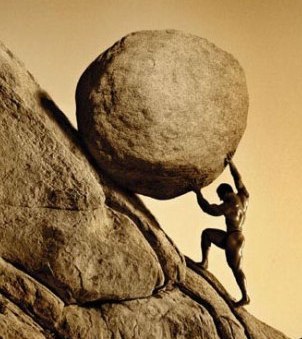
I've been feeling like Sisyphus lately.  You know, in Greek mythology, the
king punished . . .  by being cursed to roll a huge boulder up a hill, only to watch it roll back down, and to repeat this throughout eternity
My to do lists are repetitive, my days too often like Bill Murray's in "Groundhog Day."  And now that I'm getting more done, I'm more keenly aware that nothing really stays done.    


Of course, Sisyphus was working harder than I am, generally.  A truly Sisyphean task is "endlessly laborious or futile."  


My activities probably more closely resemble Tibetan sand painting, or Zen sand gardening.  In these practices, great care is taken to achieve an aesthetic effect.  The endeavor concludes with a "dispersion ritual," in which the product is destroyed and its energy released.  The point of the exercise is sacred effort and recognition of impermanence.  


The only parts I have trouble with are the sacred aspect, and that impermanence thing.  Oh, and accepting the spread of tiny particles of sand throughout my house.  Really, since one of my daily rounds lately involves visiting a series of sandboxes with my two-year-old charge.  He, actually, totally gets both the sacred and the impermanent nature of sand play.  His small face transforms with joy and reverence as he constructs his castles and bakes his "cakes."  He is equally delighted to stomp on the results.


What I take from this reflection today is that my focus needs to be on doing, and even getting done, but not on being done.  Which I will be, when I'm dead.  I need to join the ritual of everyday, and accept the routine and the repetitive along with the occasional punctuations of the unexpected.  I need to lean into the rhythms of my days.  And to pay attention to each moment, which is never precisely the same as the one before it.  

Friday, April 9, 2010

Procrastination Rituals of the Not-so-Rich and Not-so-Famous

As part of their special issue on procrastination, Slate Magazine published an article on "the procrastination rituals of everyone from cattle ranchers to CIA agents."  Embedded in this important reference work is an alphabetized interactive list of occupations which allows the enterprising reader to "mouse over" a category of interest and learn about a corresponding procrastination ritual.  For example, if you were wondering how a Major League Baseball bat boy might waste time, you could be enlightened by this entry:
Bat boy (MLB) 
Henry Freedman
Houston, Texas
"The ballpark is the best place in the world to procrastinate. You’ve got a huge stadium to play with. We’d play catch on the field, all kinds of stuff. Play any sort of game you can come up with—pretending to throw balls at the crowd. We’d do a lot of things involving sunflower seeds, spitting them, flicking them, trying to kick gum all the way from the dugout to the field. ... We had one batboy who used to sneak out to the bullpen to nap. Sometimes we brought the relievers beer out there.”
Or you could look up poet, and find that Christopher Kennedy of Syracuse, N.Y., confesses that
“I spend an inordinate amount of time selecting the song for my MySpace page. It’s really just set up for my books, but I get obsessed with showing my stellar taste in music across the decades. It’s probably really annoying to anyone who has to get an update every time I make a change to my page. …You take someone like Shakespeare—if he was writing with a computer, we’d be lucky to have four or five sonnets and maybe one play.” 
Scrolling through the list, I found I had to know how a geomancer blows off his or her responsibilities.  I had no clue what a geomancer is or does, and Ivan McBeth of Dreamland, Vt. didn't help me out much.
“Part of our training is just to sit and distill our thoughts by gazing at things. Procrastinating is one of the things we try to be aware of. And not to do. I don’t really procrastinate.”  
In fact, his was one of several claims included in this handy little catalog that would have us believe that the individual didn't or couldn't or wouldn't dream of trying to procrastinate.  In this group were air traffic controller (thank God!), astronaut, funeral director, otolaryngologist, and psychic. 


While others were perhaps more forthcoming, the range of responses led me to speculate about the specificity and uniformity of the question(s) that elicited them.  The article begins with this introduction:  
We already know plenty about how college students and office workers waste time: They check e-mail, send Facebook status updates, and—ahem—read online magazines. But what does procrastination look like for everyone else? 
The handy dandy little compendium itself follows this:  "We asked people from all walks of life to describe their procrastination rituals." 


I thought the inquiry was fascinating, and the results entertaining if not exhaustive.  So I decided to do a little research of my own.  Following their not-so-precisely described "procedure," I asked a small "random sample" of individuals, all related to me in one way or another, what they did when they were procrastinating.  Here are my additions to the "literature" on procrastination rituals.

College Student--I spend lots of time on the internet, and play games on my phone.

Federal Employee--I shop!


Psychologist--Training a squirrel (operant conditioning and shaping) instead of writing my dissertation

Schoolteacher and Mom--I clean stuff instead of doing what I'm supposed to do.

Student in On-line Program--Watching YouTube videos, comedy performances and sit-coms; checking sports scores and forums

University Professor--I'm procrastinating about doing a video for class. I can't make myself do it. It's creative, it takes psychic energy. I tried to do a lot of reading, enjoyment, prepare myself by reading, don't concentrate on it, get myself ready to jump into it, put it off and put it off, rest up for a huge expenditure of energy. I do things that are more enjoyable, biding my time before I've got to jump in.


Unnamed Blogger--[disingenuously] I can't really afford to procrastinate.  The demands of the job are too great.  And I don't spend much time on the internet so I don't have that temptation.  I'm really above all that time-wasting stuff.  [Yeah, right!]

Wednesday, March 10, 2010

Solitaire--More Than You Probably Wanted to Know

1:30 a.m.  Two days after my daughter's wedding.  My father gets up to use the partially painted bathroom, tries to steady himself on the stepladder I've neglected to remove, and crashes through the glass divider next to the toilet.  My mother summons me to the scene.  His arm is streaming blood.  "I just need a band-aid," pronounces the man who has performed hundreds of appendectomies, though none recently.  


Four hours and nineteen stitches later, we return from the emergency room to find my mother losing at solitaire.  She was concerned for my father, but almost as distressed at her unusual bad luck with Klondike.  On a hunch, I counted the cards.  Fifty-one.  She had been, literally "not playing with a full deck."  For Christmas that year, I gave her a shiny new pack of Bicycle playing cards.  And some other nice stuff, too, of course.


The very same father, in the hay days of his small town medical practice, would periodically slump into depression, signaled by days spent in his bathrobe at the kitchen table, playing solitaire.  Minus the bathrobe and the kitchen table, I took this habit to college with me.  When cramming for exams, last-minute paper-writing, and quasi-virginal sex weren't keeping me up, the wee hours were for solitaire.  Hunched over the cards on my dorm room floor, I would play until my back ached and my eyes were bleary.  


With the digitalization of everything came computer solitaire.  I, too, was seduced by the come-on of the cascading cards, the audio of applause so rare in my regular hours.  And I caved, too, under the onslaught of ever-new versions of this daddy-of-all-time-wasters.  Still hunched, but now over a laptop screen, I have played until my back ached, my eyes were bleary, and I began to develop carpal tunnel syndrome.


Computer solitaire has become the dirty little secret of millions of us, especially in the workplace.  One Mahjong solitaire program I've seen has a built-in "Boss Key" that 
[h]elp you quick hide the game when your boss coming in. Press the Space, the game will disappear from your screen, and press Space again, it can turn up.  
Such a feature might have helped Edward Greenwood IX, famously fired in 2006 from his job as a state lobbyist for the city of New York by Mayor Bloomberg, who caught Greenwood playing solitaire "on city time."   No notice, no severance pay, and the end of six years of cushy public employment at a non-Bloomberg salary of $27,000.  For playing solitaire.  In point of fact, Greenwood was not at his desk, or even in the office when his offense was detected, but away on city business.  Bloomberg Law professor and blogger Ann Althouse's post on the Greenwood affair prompted these comments:


Goesh said...
Hmmm - one would think some less harsh disciplinary action would be in order first, like a written reprimand and warning, possibly a day or two suspended without pay. What's next, doodlers? I wonder what his employee evaluations were like? I got a crisp $20 says he was doing satisfactory work. This won't garnish him many votes from government workers, that's for sure.

Freeman Hunt said...

That's pretty harsh. If we fired all the employees who we ever saw playing solitaire, I think we'd be left with only the warehouse staff because they don't have desks and computers. 

Clearly, if we're starting to jeopardize employment here, it's time to talk about addiction--something we seem to be addicted to talking about anyway, what with the sex addictions, shopping addictions, exercise addictions, etc.  And rest assured, this one hasn't escaped the attention of addictionologists.  The conversation has even trickled down to the Nickelodeon set, who have spawned a handy-dandy, if misspelled,  little
quiz we can take, to assess our problem.  Or we can check the following, from a solitaire game site  :

Here's a shortlist of solitaire addiction signs you can use to make sure you or someone you love isn't becoming a solitaire addict:
  • Getting an excited or "rushing" feeling when playing Solitaire
  • Feeling guilty about playing Solitaire but continuing to play
  • Not being in control of the amount of time spent on playing solitaire
  • Lying about the amount of time you spend playing solitaire, thinking about solitaire, or even dreaming about the game
  • Playing solitaire to deal with feelings of sadness or anxiety
  • Becoming angry when your "real life" interrupts your solitaire time
There are also a handful of physical signs that solitaire addiction could be present. These include the onset of carpal tunnel syndrome, dry bleary eyes from staring at the computer screen, recurring headaches and back pain, trouble eating, and ignoring personal hygiene.
Wheeewww!  I'm not addicted.  I never dream about solitaire, I eat regularly and with no difficulty, and I am not ignoring personal hygiene.   And thank goodness, I don't have anything remotely resembling a "workplace."


In defense of solitaire, a cause to which legions have risen in the wake of all the faint praise, some refer to it as a meditative activity.  Others claim beneficial effects including time-saving, since solitaire breaks are taken at one's desk, unlike coffee breaks which are often taken elsewhere, and lead to bathroom breaks; some kind of mystical mind-meld thing where higher order problems get solved while the brain is busied with low-level card manipulation; brain stimulation in playing of more complicated games, which can stave off Alzheimer's; and anxiety-reduction. 


Josh Levin's 2008 Slate Magazine piece (in their special edition on procrastination), entitled "Solitaire-y Confinement: Why we can't stop playing a computerized card game," is a useful compendium, part history, part analysis, part light-hearted examination. He makes the point that solitaire put-downs have become a throwaway barb because so many of us hide this part of our lives.  And he admits that he struggled to quit playing solitaire long enough to write the article.  He credits our common preoccupation with the advancement of computer familiarity and usage, and pacification in the modern office.


I have often wondered, in between games, what I might have gotten accomplished had half of the hours I've spent on these games, once dubbed "patience," and also referred to as "kabal," been spent more productively.  What might we as a society have achieved?  It boggles the mind.  Although, if I get to count those hours as meditation time, I'm already Buddha!  From a long, proud line of Buddhas.

Wednesday, January 13, 2010

Burning Off: Communing in Flame

Fire has been presenting itself to me as metaphor, solution and ritual of late.  This past Sunday, I attended a “Fire Communion” at my Unitarian church.  Having been born into Catholicism, I’m a sucker for communions of all sorts, and this denomination of religious refugees provides several—flower communion, water communion, bread communion.  This was my first fire communion.

The artfully organized service contained several elements that provoked, quieted and inspired me.  But the centerpiece was the opportunity to write words on a small piece of flash paper representing a story I wished to let go of, and to add this story to those of others being released into the fire.

I have been moving into a time of sorting, assessing, reclaiming, and discarding over the last few months.  I’m not sure where this is coming from, but I suspect that my impending empty nest, the significant birthday this year will bring, and the continuing process of trying to come to terms with the death of someone I loved all my life are acting together to fuel this consuming process.  So I was more than ready to consign any one of several outgrown stories to the flames.  But I had been told to use one piece of paper.  Being generally compliant—see Catholic background reference above—I didn’t think of violating this instruction.  And even if I had, it was hard enough to scribble a few words on one square of what turned out to be quite fragile paper in the time allowed.  I was forced, therefore, to settle on one story to relinquish.

I was taking this exercise seriously, and felt the compunction to identify the most important story to leave behind.  Or the story that subsumed the others.  The ultimate old story.  My ultimate old story, at this moment. 

As I moved to the front of our sanctuary to claim my piece of paper, I considered my choice, and struggled with language.  When I gripped my pencil, the words came to me.  I wrote “the wind beneath everyone else’s wings,” with no little difficulty, primarily because of the tendency of the sharp lead to puncture the paper fragment, but also because I wanted the words to be perfect—perfectionism another story I might have chosen to incinerate.

What did these words mean?  What story did they stand in for?  And what will it mean to move on from it?  What story will take its place?

Despite the cheesy Bette Midler throwback, I meant to convey my readiness to claim more of my energy for my own.  I have been immersed in nurturing others for more than three decades, and it feels like time to shift the balance.  My children, who have been the chief “beneficiaries” of my absorption, my husband, my aging mother, and my sister who has the major responsibility for Mom’s on-site support, hold the largest liens on my life.  And I am not planning to abandon any of them.  I intend to continue as the main caregiver for my two-year-old grandchild, nurse practitioner for my much-loved dog, underpaid nonprofit employee, and social justice activist in my church and other contexts. 

But I have depleted myself too much in all this caretaking, caregiving, and just plain caring.  I have allowed my nurturing self to devour equally important parts of my identity.  And I need to let go of the idea that any or all of these beings and causes will plummet to earth without my constant attention.  I can, and have to, begin to live more in my own life.

When my turn came, I dropped my words into the makeshift cauldron, savored the satisfying pfffft as the fire caught, and returned to my seat, leaving behind the carbon residue of my tired narrative.  I am eager to see, as the smoke clears, what emerges.

Friday, January 8, 2010

Dealing with the Undead

According to Wikipedia, "[u]ndead is a collective name for fictional, mythological, or legendary beings that are deceased yet behave as if alive." Sounds like my dissertation to me. And probably some of the other unfinished business clogging my thought processes, blocking my chi, and taking up storage space in my dwelling.   


The Wikipedia entry goes on to tell us that "[i]n some cases, the undead, especially skeletons and zombies, are under the control of a necromancer. In other cases, such as zombies as depicted in film, the undead existence is passed on like a curse or disease. . . .Ghosts are said to be kept in their undead state by willpower, either from a keen desire to remain with the living or from a wish to see something completed that they could not do during their lifetime. Revenants are a corporeal analog for ghosts in this manner, their independence setting them apart from the typically mindless skeleton or zombie. However note that, while ghosts are sometimes portrayed as benevolent or at least innocuous, the appearance of a revenant in folklore or fiction is almost universally horrific..." 


So now we are in the realm of necromancy.  Who knew?


More seriously, and more frightening, I find much of relevance in the above passage.  For example, "the undead existence is passed on like a curse or disease."  I have felt that my uncompleted dissertation has infected other projects, and even my whole work process.  And "[g]hosts [unfinished dissertations, etc.] are said to be kept in their undead state by willpower, either from a keen desire to remain with the living or from a wish to see something completed that they could not do during their lifetime."  And then there is the clearly pertinent verdict that such things are "almost universally horrific."


Okay.  So it's a bad thing that I continue to be haunted by this costly "failure to launch."  And to give space in my head, my study, my attic, several generations of hard drives, and my gut to what amounts to a stillbirth.


But what do I do about it?  How do we deal with such bothersome creatures?  Again, Wikipedia tells us of "[r]ituals propitiating the uneasy spirits of the dead [that] were a feature of ancient Greek religion (keres), ancient Roman religion (lemures), and Hinduism."  So a ritual, then.  And because I'm really more of a do-it-yourselfer when it comes to ritual, and because I don't have the kind of time required to mount an exhaustive search for an appropriate template through the annals of time, it would seem that it's on me to figure out how I might lay my  academic ghosts to rest.


A man I met long ago in poet circles shared his dissertation-zombie story with me.  After trying unsuccessfully to gift his mountains of data, notes and text to the state historical society--they wanted him to digitize his largesse before they would accept it!--he decided to build a bonfire and throw into it every scrap, every flake, every dissertational wisp, and to watch it burn.  His dreams and efforts literally going up in smoke.


I have kept this image all these years, for a reason perhaps.  But I am not ready.  The research I conducted, the stories I collected, and the impact they had on my life have their roots deeply planted in me.  I fear their removal, kind of like the surgical excision of a conjoined twin.  There is something of sacrilege about the idea of consigning this spector to the flames.


This may be the hardest thing for me to "put to bed" ultimately, harder even than totally obsessed mothering, which is another force to be reckoned with.  For today, I will try to keep moving and working, and accepting that I am not there yet.  A picture of Professor Quirrell in the first Harry Potter book, a purple garlic-scented turban covering his head, onto which the not-yet-completely-dead Voldemort had grafted his being, flashes before me--my dissertation as "[s]he who shall not be named."