Nothing is so fatiguing as the eternal hanging on of an uncompleted task. ~William James
Showing posts with label unfinished. Show all posts

Wednesday, December 29, 2010

2010--The Year in Rearview, Part I

As I wade into the day this morning, I am made aware that the world around me is in an end-of-the-year mood of reflection.  Those in a position to know, or to think they know, are weighing in on the events of the last 363 days.  For example, Yahoo's Year in Review; and Twitter's; and YouTube's.  Or this from CNN.  Those so inclined can revisit the year's top movies, books, sports happenings, political remarks, and financial occurrences.  And for those like me who shield ourselves from negative messages, Esquire puts a positive spin on its look back, compiling, for the waning 2010, "One hundred and two reasons to celebrate, with videos."


I am preparing my own list of things I put to bed over the past year.  But today I am watching the last grains of sand slip heedlessly through their narrow glass passage, and feeling the import of those things I have not finished.  I am fighting the impulse to slam into some ultra gear and speed through a few more projects before midnight on Friday.  As of this moment, the year's countdown timer in this blog's sidebar informs me that I have 2 days, 13 hours, 10 minutes and 59 seconds, no 58, no 57, . . . to get it all done.  But since my other strong impulse is to give in to holiday week lethargy, it's pretty clear that I'm not going to go out with a bang in late late 2010.


2010 will not be the year I published my first book; finished cleaning and organizing my basement; re-conquered my fear of blood pressure cuffs; travelled to Ireland; mended the rifts in my step-family; ended my dance with procrastination; achieved buddhahood; reclaimed my gone-wild yard; found the key to my sons' futures; achieved my ideal weight; produced heart-stopping poetry; gained fame as a blogger; unsnarled my family's health bills and insurance communiques; brought my marriage back to its former glory; healed my frayed emotional state; or learned how to grieve for my father.  And the 2 days, 12 hours, 53 minutes and 32 seconds, no 31, no 30, . . . left are not nearly enough to advance these goals.


All that's possible, or sensible, I guess, is to keep moving forward, or in whatever direction looks like forward at the moment.  And to keep dropping those drops into the bucket.  And to try to see these artificial time allotments as little signposts, or mileage markers along the way, rather than as yet more deadlines.  (And we all know how much I love deadlines.)

Friday, November 5, 2010

Gorillas in the Midst

It has lately come to my attention that my particular form of multi-tasking generally involves, not actively trying to do more than one thing at a time, but rather flitting from task to task like a bee too juiced up to focus, leaving in my wake a profusion of things in the making.  You know, like the film trailer tag, "Ten years in the making, . . ."  Only somehow it doesn't have quite the punch when I use it to describe an embroidered Christmas tree skirt.  Or an organization system for my kitchen junk drawer.  Or my bed. 


It has helped to pare down my to-do list each day, and to set focus goals each week.  But I'm still completion-challenged.  


Some of the many books I've read on writing--in what I thought was preparation for, but turned out to be instead of, actually writing--advocate ending the day's work in the middle.  This can mean that we shouldn't stop at a chapter break, or be taken so far as to suggest quitting in the middle of a sentence, or even having typed only part of a word.  The idea is that this fragment of what comes next will prompt or jump-start the next day's writing.  Is that why I'm littering my life with incompletes?  So that I'll always have something before me that invites action?


Or have I just never developed the habit, or the discipline, to stick with a thing until it's finished?  Or is the rhythm of my life so recurringly interrupted, and adherence to my own plans and commitments so shaky that I'm continually being jarred off course?  Could this have anything to do with being a mom?  Like how we needed to learn a new way to hold conversations, which involved growing the ability to retrieve lines of thought derailed by refereeing toddler disputes or responding to urgent requests for potty assistance, permission slip signing, or brief psychotherapy?


Or like just now, when my online high schooler answered his cell phone as I was writing this post and preparing to head for the office.  Suddenly I am rerouted to a distant suburb where the standardized test appointment he overlooked is in progress.  So I shorten the post (to be continued next week), skip my shower, call in late for work, and head for the hills, or the falls, or wherever.


And now I get it.   Stay tuned for what I intend to do about it.


Friday, September 17, 2010

Vacation Reruns, Part 2

Day 2 of vacation.  Here is the second of the blog posts chosen by my husband to run while I'm away.  He says "I have no defense for the choice of this post."


WEDNESDAY, JUNE 30, 2010

In Defense of Blogging


My husband is bored with my blog.  He's had enough of procrastination, posted and real-life.  He is of the opinion that writing about procrastination is getting in the way of writing.  He could be right.


I am spending an average of an hour and a half per day writing these posts, and solving the intermittent technical glitches that interrupt their publishing.  At the rate of two pages per hour, the blog may be "costing" me about 15 pages a week.  Not that all of those 15 pages would be ultimately usable.  But they probably need to be written anyway, as what poet William Stafford called "scaffolding" erected in the process of writing a finished piece.   


On the other hand, I am reluctant to abandon or foreshorten what has been a useful vehicle.  This blog has allowed me to reflect on why I have put off things I want to do and things I have to do, and failed to finish so much of what I have started.  It has prompted me to read more widely and deeply about procrastination, to discover what research is being done and what it reveals, and to identify some strategies that may prove valuable.  I am clearly not done with this subject, as the problem itself has taken deep root in my life.  If we use the "pregnancy weight" maxim--"Expect it to take as long for the weight to come off as it took to put it on"--I could be at this for years, if not for life.  


Blogging about procrastination has also gotten me writing regularly, and with purpose.  No small accomplishment, given my previous starts and stops.  Something about the public nature of the venture--even if my "public" is small, and sporadic, and seeded with friends and family--and the commitment I've made to regularity keeps me juggling obligations and schedules and unseen occurrences to make sure I get this done, five days a week, every week.


And then there's the fact that I enjoy doing it.  The process itself, as so many of us have discovered, is fun!  I look forward to opening the blog "dashboard" and finding out what I have to say.  And I like having a Google presence in addition to my 2004 dismissive mention on the Dummocrat site.  I love hearing from readers who like what they've read, or take issue with it.  I love seeing my "visitor map" sprinkled with dots all over the globe, and imaging the reader in Sweden, or the Phillipines, or Kansas.  I enjoy learning the new skills and tricks involved in blogging, and feeling a part of the community of bloggers, so many of them contributing work I respect, and admire, and am made wiser by.


So, for this day anyway, I choose "to blog."  And recognize that my husband is not really "one of us," the procrastinators of the world.

Wednesday, June 30, 2010

In Defense of Blogging


My husband is bored with my blog.  He's had enough of procrastination, posted and real-life.  He is of the opinion that writing about procrastination is getting in the way of writing.  He could be right.


I am spending an average of an hour and a half per day writing these posts, and solving the intermittent technical glitches that interrupt their publishing.  At the rate of two pages per hour, the blog may be "costing" me about 15 pages a week.  Not that all of those 15 pages would be ultimately usable.  But they probably need to be written anyway, as what poet William Stafford called "scaffolding" erected in the process of writing a finished piece.   

On the other hand, I am reluctant to abandon or foreshorten what has been a useful vehicle.  This blog has allowed me to reflect on why I have put off things I want to do and things I have to do, and failed to finish so much of what I have started.  It has prompted me to read more widely and deeply about procrastination, to discover what research is being done and what it reveals, and to identify some strategies that may prove valuable.  I am clearly not done with this subject, as the problem itself has taken deep root in my life.  If we use the "pregnancy weight" maxim--"Expect it to take as long for the weight to come off as it took to put it on"--I could be at this for years, if not for life.  


Blogging about procrastination has also gotten me writing regularly, and with purpose.  No small accomplishment, given my previous starts and stops.  Something about the public nature of the venture--even if my "public" is small, and sporadic, and seeded with friends and family--and the commitment I've made to regularity keeps me juggling obligations and schedules and unseen occurrences to make sure I get this done, five days a week, every week.


And then there's the fact that I enjoy doing it.  The process itself, as so many of us have discovered, is fun!  I look forward to opening the blog "dashboard" and finding out what I have to say.  And I like having a Google presence in addition to my 2004 dismissive mention on the Dummocrat site.  I love hearing from readers who like what they've read, or take issue with it.  I love seeing my "visitor map" sprinkled with dots all over the globe, and imaging the reader in Sweden, or the Phillipines, or Kansas.  I enjoy learning the new skills and tricks involved in blogging, and feeling a part of the community of bloggers, so many of them contributing work I respect, and admire, and am made wiser by.


So, for this day anyway, I choose "to blog."  And recognize that my husband is not really "one of us," the procrastinators of the world.

Friday, May 21, 2010

Finishing School


In one of the first posts of this blog, I mentioned having considered "Finishing School" as the blog's name.  I had intended it, of course, as a play on words, since a traditional "finishing school" is somewhere I would never have been caught dead.  


In the historical sense, a finishing school was "a private school for girls that prepares them for society by teaching social graces and accomplishments."  Modeled after Swiss and British establishments, 19th century American finishing schools were intended to return a young lady 
home "finished" and prepared to grace her father's house and to enjoy the freedom of a debutante while she practiced the arts and graces learned at the academy.
'Northwestern Chronicle, July 3, 1884; St. John's University Record, 1:55 (May, 1888) 
American finishing school curricula generally included French, music and drawing, and etiquette (or "charm"); other subjects could extend to quilling (paper filigree), "the fine art of fainting," elocution, poise, English, and other, more academic fare, as some of these institutions went on to morph into women's "seminaries" and colleges.
The term finishing school is occasionally used in American parlance to refer to certain small womens colleges, primarily on the East Coast, that were known for serving to prepare their female students for marriage. Since the 1960s, many of these schools have become defunct as a result of financial difficulties stemming from parents [sic] decreased interest in paying for such an education for their daughters, and the rise of feminism making it easier [sic] for daughters to follow loftier goals. (From Wikipedia)

In any case, finishing schools being generally a thing of the past, and the blog name already taken, "Put it to Bed" was born.  But I remain in need of learning how to finish.  And not, with the exception of my kitchen cabinets project, wood finishing.


And so I am trying to develop a "curriculum" that will encourage the needed behavior, or skill, or mindset.  By way of establishing a benchmark, I observe that my alacrity in starting things is not matched by my ability to limp across the "finish" line.  And that's putting it mildly.  More than four months ago, I posted "Stuff I've Been Putting Off," which detailed some of the things I haven't managed to be done with over a period of several years.  Since then, I've completed one of the tasks on that list of 15.  I called my brother, more than a month ago.  But he "wasn't available to take [my] call," and hasn't responded to the message I left, so that probably doesn't count.  Of course, I haven't called back, either.  Suffice it to say, I am still "completion-challenged."


A potentially fruitful idea came to me this week, as I was struggling to work on my late-spring housecleaning project.  I watched myself buzz from cleanup task to cleanup task, like a bee suffering from blossom-mania and unable to light on any one flower.  And I thought that maybe there was something to be gained by practicing finishing, on a small scale, disciplining myself to work through to the end on things I take up.  Perhaps I can build a muscle of denouement in this way.  


So this morning, I finished cleaning the microwave before I moved on to writing this post.  Not perfectly, but completely.  And I am challenging myself to bring to conclusion the odious task of filing my son's homeschool transcript in the form required, instead of the form I earlier provided it in.  If this improvement effort doesn't make me more marriageable, perhaps I will better 
grace [my own home], and ...enjoy the freedom of a [more effectively recovering procrastinator] while [I] practice the arts and graces learned at [this] academy.

Friday, April 16, 2010

To Do, Endlessly


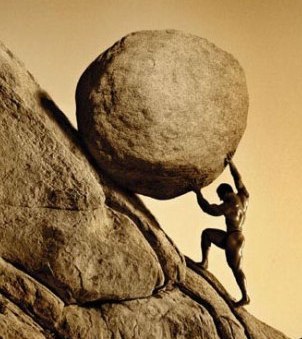
I've been feeling like Sisyphus lately.  You know, in Greek mythology, the
king punished . . .  by being cursed to roll a huge boulder up a hill, only to watch it roll back down, and to repeat this throughout eternity
My to do lists are repetitive, my days too often like Bill Murray's in "Groundhog Day."  And now that I'm getting more done, I'm more keenly aware that nothing really stays done.    


Of course, Sisyphus was working harder than I am, generally.  A truly Sisyphean task is "endlessly laborious or futile."  


My activities probably more closely resemble Tibetan sand painting, or Zen sand gardening.  In these practices, great care is taken to achieve an aesthetic effect.  The endeavor concludes with a "dispersion ritual," in which the product is destroyed and its energy released.  The point of the exercise is sacred effort and recognition of impermanence.  


The only parts I have trouble with are the sacred aspect, and that impermanence thing.  Oh, and accepting the spread of tiny particles of sand throughout my house.  Really, since one of my daily rounds lately involves visiting a series of sandboxes with my two-year-old charge.  He, actually, totally gets both the sacred and the impermanent nature of sand play.  His small face transforms with joy and reverence as he constructs his castles and bakes his "cakes."  He is equally delighted to stomp on the results.


What I take from this reflection today is that my focus needs to be on doing, and even getting done, but not on being done.  Which I will be, when I'm dead.  I need to join the ritual of everyday, and accept the routine and the repetitive along with the occasional punctuations of the unexpected.  I need to lean into the rhythms of my days.  And to pay attention to each moment, which is never precisely the same as the one before it.  

Monday, March 8, 2010

Done for the Week: A Bad Cold Ate My Week

I am less than thrilled with the list that follows. But I should be okay with it.  If I learned anything from reading Mary Pipher's book, Seeking Peace:  Chronicles of the Worst Buddhist in the World, it is the importance of self-forgiveness.  And why should I even need to forgive myself for the hardly cardinal sin of being sick, or being human?  

I think my reaction is a residual of being raised as a doctor's daughter--the healthy one, at that.  Growing up, we chided each other that being sick was bad advertisement for Dad's medical skills.  And I secretly disliked the not-so-sick who called at all hours of the day and night, interrupting every family outing and celebration.  

As an adult, I have seldom done the kind of work where sick days were an option.   I have been blessed with darn good health overall, but when I do get sick, I generally try to work through it.  Succumbing to the need for rest and a reduced work schedule feels like malingering to me.  

This morning, after three days of  inactivity forced by fever, body aches and a racking cough, I awoke feeling slightly better.  Just in time to start another hectic week. And disappointed, mostly, about my inability to complete Week 9--what should have been the final week--of my 5K training.  My daughter/coach has been admonishing me not to resume training until I am well, and reminding me that even great athletes (whose ranks clearly do not include me) get sick, and injured, and have to rebuild.

Perhaps I am most troubled that my list for last week doesn't really look all that different from those of previous weeks.  

Done List--Week of Mar. 1-Mar. 7

  1. Completed Day 1 of Week 9 of Couch Potato to 5K Training
  2. Got sick, and then sicker
  3. Finished Sold Down the River by Barbara Hambley; Seeking Peace:  Chronicles of the Worst Buddhist in the World, by Mary Pipher
  4. Walked my semi-grateful dog one day, got family members to do it 2 others
  5. Took my blood pressure daily
  6. Survived two part-time jobs for another week, working while sick
  7. Attended 2 meetings
  8. Published 5 blog posts
  9. Meditated once
  10. Started letter to my dead father, as instructed by therapist
My plan for the coming week is to get over my illness, and get over myself.  As I cough my way into the first hours of Monday, I will try to ease into the resumption of routine, and to leave time for resting.  I look forward to getting my potato uncouched when my lungs clear. 

Tuesday, February 23, 2010

Procrastinating 101: Achieving Behind Our Own Backs


                        Click here to buy the t-shirt


I am always on the alert for ways to turn my faults into virtues. I was thus enchanted to come across Stanford professor John Perry's notion of "structured procrastination." On his website devoted to the approach, Perry tells us that in practicing structured procrastination 

one is in effect constantly perpetrating a pyramid scheme on oneself.

He goes on to say that 

virtually all procrastinators have excellent self-deceptive skills also.   And what could be more noble than using one character flaw to offset the bad effects of another?
So how exactly does this noble strategy work?  How do we turn our task-avoidance flax into gold?

Perry, himself a prolific producer of academic work whose curriculum vitae boasts a long and impressive list of books and articles, parts company with those who would have us eating frogs and beginning with our highest priority tasks.  He advises, instead, that we maintain lists full of useful and important things to do, topped by something we want to put off.  In his words,

the procrastinator can be motivated to do difficult, timely and important tasks, as long as these tasks are a way of not doing something more important.  
The ideal "top priority" task, in Perry's view, is one that seems crucial, but isn't really; and one that appears to have a firm deadline, but doesn't really.  Clearly, we wouldn't want to put "Administer CPR to stricken family member" in that position.  Nothing else we could accomplish while postponing lifesaving measures would yield satisfying results.  Or make us look particularly good (saving face), which is part of the appeal of Perry's method. 

I'm thinking, in my own case, that "finish dissertation" probably functioned in this way for me, for years.  Clearly, "the dreaded d-word" was my frog for much of that time.  In Alan Lakein's schema, outlined in How to Get Control of Your Time and Life (1973), production of the anticipated tome was my "A1" task.  In the words of Ford's retired ad campaign, it was "Job One."

And yet, while not doing my dissertation, I managed to parent three children, become a performance poet, teach college, become a special education paraprofessional, refashion myself as a self-trained low-level healthcare worker, co-author a smattering of important academic articles, rewire my stove, build a backyard fence, plunge countless toilets and unclog legions of sluggish drains, abide by most laws, make and keep friends, join a new religion, participate in endless numbers of protests and rallies and campaigns, take up meditating, and other achievements and milestones "too numerous to mention."  I was obviously not idle.

The problem I have with this style of procrastination--we might call it "Procrastination Lite--is that I still feel so bad about not doing the thing I most wanted to do.  You could say I'm onto myself.  I'm no good at the "man behind the curtains" ruse.  No Madoff, I.  I see through my efforts to dazzle myself with this plethora of feats.  Under it all, I am still A.B.D., and will most likely go to my grave so. (Hopefully, no one will be crass enough to chisel the letters in stone above me.)

Although, if I think about it, my dissertation probably never belonged in the place of "honor" at the top of the list.  As a mother who experienced the arrival of each of my three children as the result of a different form of Himalayan trek, I always valued them above all else.  I have said many times that, when "push came to shove," my kids came first.  And push just kept coming to. . . you guessed it.

It probably makes sense to give myself some credit for having managed to fool myself into doing what mattered most.


Wednesday, February 10, 2010

When Plans Go Awry


One of my favorite coffee mugs was given to me by one of my children.  It was black, with white lettering declaring that "Shit Happens."  I used to drink from it daily, to remind myself--as if I needed reminding--of life's vicissitudes.  Of course, after a relatively brief reign of intact splendor, "shit happened" to my cup.  It was repurposed as a miscellaneous container and lived in deeply chipped glory on my bathroom vanity, beverageless--until some more shit happened.  The cup is gone, but the shit continues.


I'm not sure why so many of us seem to rely on life being routine and predictable.  Between hurricanes and earthquakes and terrorist attacks, you'd think we'd get the message.  And how about all those mugs, t-shirts, bumper stickers and bestsellers marching across our consciousness, driving home the same point?  WE ARE NOT IN CONTROL!  But damn, we want to be.  And none more than me.


And yet the free spirit in me frequently contrives with the evil genie of life to place myself square in the center of the action.  I'm the one adopting as a single parent; taking the insanely demanding job; dating and then marrying the passionately work-obsessed world-changer with three kids; commuting to New Orleans; woman-ing the barricades.  Giving myself no quarter.


But this seemingly brave self is a front.  I definitely "Feel the Fear and Do It Anyway," as the popular self-help book advises.  And then here I am, shaking in my boots, when the you-know-what starts rolling in.


I've managed over the years to ride some pretty big waves, if not with alacrity than at least with aplomb.  But it's the little stuff that threatens my composure and, more to the point, my recurring efforts to reform. It's the first day missed of a new exercise regimen, or the first bite of forbidden dessert, or the bed once unmade, or the dishes left undone that undoes me.  Perfectionism raises its ugly little head and tries to take me down with its venom.


I've been holding my breath the last few weeks, waiting for the shoe of the unexpected to drop.  And frankly, I'm surprised it's taken this long.  Although, looking back, I see that I've been looking ahead for routine-busters and planning my moves around them.  Early morning meetings?  Get up earlier to blog.  Scheduled 5K training time encroached upon?  Reschedule for later in the day.  Sick kids?  Scale back the to-do list, make the chicken soup run or the doctor's appointment, and keep going.


But I didn't see yesterday coming.  All my adroitness in shushing around the moguls of an early meeting, followed by back-to-back commitments, a much-heralded snowstorm, getting plowed in at one job and having to dig out, rescheduling my workout--and thinking I'd dodged a bullet when at least the gym stayed open--couldn't save my scheduled training session.  A friend from the job that didn't plow me in  called as I was heading out, needing a long confidential talk I'd promised earlier and forgotten.  When I got off the phone, it was too late to get to the gym.  And jogging in a blizzard would clearly not do.  And by then literally "off track," I didn't walk the dog.  And I didn't substitute meditating at home for my snowed out meditation group.  At the end of a busy, crazy day, I had expended lots of energy but accomplished very few of my own core tasks, the ones that signal to me that I'm trying to do things differently.


So I wake up this morning dreading "the slide."  You know, that downward drift set in motion by some unplanned interruption and the small resulting "failure," and the sense that we can't hold back the tide of that substance celebrated by my luckless cup.  And really, why bother trying?


But platitudes and maxims swim in my head.  I need to "just do it," "get back on the horse," and "keep going" though the going will probably get tough.  I can squeeze yesterday's workout into today.  My dog will get his walk.  I can meditate before work.  I can continue scanning the daily horizon for bummers and surprises, and coming up with midcourse corrections.  And I can try to keep enough air in my schedule that I can implement hastily crafted Plan B, or C, or L, or even Z if it comes to that.


And I can stop fooling myself about the amount of control I can expect in this crap shoot, and stop aiming for 10's.

Tuesday, February 9, 2010

Procrastinating 101: The Perfect Cure for Perfectionism


Last week, I wrote about the six types of procrastination posited by Dr. Linda Sapadin in her book, It's About Time:  The 6 Styles of Procrastination and How to Overcome Them.  (Who knew procrastination could be "stylish?")   I was hardly surprised when the book's self-assessments identified perfectionism as among the major pillars of my problem with procrastinating.  Although I sometimes have trouble recognizing this tendency of mine--what with all the imperfection so obviously in view in my life and environs--I have repeatedly had this trait pointed out to me by friends and loved ones, co-workers, casual acquaintances, door-to-door salespeople, and people standing in line behind me at the supermarket.


A quick trip through cyberspace reveals that perfectionism has become something of an industry.  Just "googling" the word brings up "about 926,000" results.  And none of them are exactly endorsements.  In browsing, we learn that perfectionism is akin to, or can lead to, or may result from the dreaded OCD, or eating disorders, or anxiety, or depression, or "other mental health problems."  It has a "pathological form," "10 telltale traits,"  and "pitfalls."  We are offered guidance in "escaping," "coping with," "overcoming," and "freeing our families" from this scourge.  One source warns us ominously about "perfecting ourselves to death."  Endless quizzes and inventories are available to "help" us determine our risk levels and severity of affliction.


But what does it have to do with procrastination--other than providing diversions such as the pursuit of the "perfectly documented" blog paragraph on the subject?


According to Dr. Sapadin, we perfectionists tend to respond to tasks and projects in one of two ways:  either we "overwork" in a futile attempt to achieve perfection in the finished product, completing something minutes before the deadline or actually late, despite having begun work early and given continuous and strenuous effort; or we are so intimidated by the impossible standards we have set that we can't get started at all.  The latter approach leads to shoddy last-minute efforts, or to outright failure to complete work.  (Hmmm. . . sounds familiar.)


In my own case, I have long been aware of the contribution of perfectionism to my failure to complete my dissertation.  My response was of the first type, with years spent in preparing perfectly to write the perfect questions which when put perfectly to my perfectly selected "subjects" would lead to perfect understanding which would then be communicated perfectly; years spent writing and rewriting, punctuated by years spent anxiously putting off writing.  A painful cycle that has colored subsequent work patterns and dented my self-esteem. 


Perfectionism lies behind the trepidation I feel in the face of to-do lists.  Fortunately, for me anyway, it does not seem to be hampering my production of this blog.  I have been churning out these imperfect essays regularly for over a month now, and am at peace with their warts.  I have come to the place where I want to finish things more than I want them to be perfect.  So having completed this morning's halfway-decent post, I will go into my less-than-pristine kitchen and enjoy the coffee made for me by the mutiply-flawed love of my life--and try not to mention the grounds.

Friday, January 29, 2010

You Might be a Procrastinator if…

The list below may be a bit too wordy for a t-shirt, but is intended to provide the kind of small chuckle that could just keep us sane--more or less.

You Might be a Procrastinator if…

  1. Your mirror is littered with urgent to-do (but still undone) post-its from more than 5 years ago.
  2. You still have maternity clothes in your closet, and your youngest is a teenager.
  3. Your bills are in arrears, despite (sort of) having the money to pay them.
  4. The person you were going to send a sympathy card to “right away” is now dead her/himself.
  5. Library overdue fines are a standard part of your budget.
  6. A household improvement you began 10 years ago remains unfinished.
  7. You put off buying tickets for a planned trip and now have to fly standby.
  8. You routinely mail presents six or more months after the event.
  9. Your mending pile is full of items that no longer fit anyone in your house.
  10. You are blogging about procrastination.
  11. Six or seven stalled-out major work projects lie in wait on your desk.
  12. You just can't make yourself "act now," even though "operators are standing by."
  13. Way too many of your ships have sailed without you.

Not the definitive list but hey, it’s Friday, and I’ve worked hard all week.  I’m going off to play.  Just have to get dressed (it’s only 11:00), make my way around the piles of bills, unmailed sympathy cards, and deserted ship docks, and find the door.

Thursday, January 28, 2010

Please Don’t Say the “B” Word


My (b-a-s-e-m-e-n-t) has been on my mind the past few weeks, as I’ve been trying to face my backlog and get my life in order.  My bedroom, if I loosely use that term to refer to the space where my bed lives, is in my (b-a-s-e-m-e-n-t), so it’s a place I visit regularly.  And not without dismay.

The subterranean level in question is partially finished.  The concrete block walls are painted in some areas.  There are rugs on the cement floor defining “rooms.”  Walls and doors separate spaces within one half.  We added a fairly well-appointed full bath when my sixteen-year-old was a baby, and an egress window about ten years ago, which makes it legal to sleep “down there.”  But this territory, containing almost as much square footage as our ranch’s first floor, remains a work in progress.  Or more accurately, a work in need of progress.

In the immediate aftermath of Katrina, roughly four-and-a-half years ago, I made matters worse.  Much worse.  My husband had been dispatched to Mississippi to meet my evacuated parents and bring them to stay with us; I spent that anxious period laboring to vacate our first-floor bedroom and create a makeshift assisted-living facility in its place.  This entailed moving in and assembling borrowed beds, making minor plumbing and other modifications in the adjacent bathroom, and making the public rooms friendly for my father’s newly acquired, and much despised walker.  It was a busy, crazy several days as our newest household members made their way north at the snail’s pace dictated by shock and malady.  I have described what I did to our dismantled sleeping quarters during that time as opening up the (basement) door and throwing our bedroom down the stairs. 

Of course, gratitude to my spouse, who would spend the first months of an overdue sabbatical surrounded by a grumpy teen, a grumpier preteen, two dislocated elders (in-laws, to boot) and an antique Bichon, did inspire me to make some efforts.  I managed to set up our bed and get the sheets on before he returned from his rescue mission.  Somewhat later, I put up pictures and bought new bedding we could barely afford to distract us from our new low rent location.  But the items that had previously been crammed into this “oasis” had been displaced to the rest of the now thoroughly disastrous space. 

Meantime, my husband was sitting in the middle of the kitchen most days, working on the book he had started on the road while waiting for my parents to get ready for each day’s travelling.  And my father was sitting at a nearby table, fretting.  He had absorbed the facts about the morass of stuff one floor down from where he sat.  And he wanted to help.  In the best of times, that would have been an impractical proposal.  In our post-Katrina state, it was flat-out impossible. 

We spent a good deal of the first several weeks after the storm looking at images of devastation, on TV and on the internet.  We were trying to gauge how my parents and my sister’s family had “made out”—a subject that would still begin most conversations in their community on Lake Poncetrain for many months after people began trickling back.  So we knew what real chaos and destruction looked like.  Our disarrangement was like a bad migraine in the face of a brain tumor.  But I did apply what I learned about the power of pictures to disabuse my father of the dangerous idea that he should brave the deep to offer assistance.  (In retrospect, I begin to understand that his desire to help was probably more global than I realized then.)

A few weeks into our adventure in extended family living, we celebrated my birthday, in the midst of emergency room trips, my mother’s growing, and frightening, illness and disorientation, my father’s accelerating physical deterioration, my teenager’s bumpy adjustment to a new school, my husband’s determined digital scribbling, my sister’s reports from their exile, and other relaxing occurrences and conditions too numerous to want to think about, ever again.  My family gave me a digital camera.  After snapping pictures of my cake and my gathered family members, I opened the instruction manual.  In three languages, it announced that I could display my pictures on our TV set. 

I decided I would use this new technological capability to show my dad why I was not going to accept his offer to help me straighten out the (you know what).  The pictures of things strewn and things piled and things sliding around down there were all he needed.  End of subject.

We are four-plus years on from that period of our lives, and still recovering.  Much effort has been expended, mostly by me, in the interim, to make our underground dwelling space habitable.  But we are not there yet.  I battle it back, but anarchy continues to creep back in, as if from the walls.  I begin to think an exorcism may be in order.

My sister recently shared this bit of dark post Katrina humor, which manages to congratulate Gulf Coast residents on their "good fortune."  In the conversations about household clutter that represent both a return to a facsimile of normal and a reference to their continuing special circumstances, standard tongue-in-cheek advice among the locals begins with "Don't have a basement." 


Wednesday, January 27, 2010

Any Better Designations?


Wikipedia (in its infinite wisdom) tells us that
[t]he term all but dissertation (ABD) is an unofficial term identifying a stage in the process of obtaining a Doctor of Philosophy (Ph.D.) degree or equivalent research doctorate (Ed.D., EngD, D.Sc., etc) in the United States and in Canada. At this stage the student has not earned the Ph.D., but has completed the preparatory coursework, qualifying examinations, comprehensive examinations, and defended his or her dissertation proposal.  
 Roy Jacobs says that
[t]his little phase ... will cause countless moments of anxiety and is the academic equivalent to purgatory. ...You are that close to a significant milestone in your life, and also almost as far. ... [Y]our life must seem like it is on hold.
The internet is teeming with solutions to the dilemma of existing in this state.  Forums, consultants, blogs, checklists and therapies abound, all aimed at completion of the dissertation, and ultimately earning a Ph.D.  My fairly extensive search has not turned up any strategies for living with the ABD as a terminal condition. 

I have been A.B.D. since 1986. Yike! I just did the numbers, and confronted the fact that 1986 was 24 years ago! Almost a quarter of a century! Of course, the nail in the coffin of my academic dreams was hammered in a mere decade ago, so my life has not been “on hold” for all that time. I have accepted that this is one ship that has definitely left the harbor, and one that I don’t plan on ever swimming after. But what I haven’t completely dealt with is the taint of failure that trails those three little letters. It's a bit too much like having an official "incomplete" on the transcript of your life.

For a while now, when some social or professional occasion requires revelation of this “status,” I have jokingly explained to the uninitiated that ABD stands for “all but dead.” However, I have come to believe that the words we use contribute to shaping our reality. Since I don’t want to think of myself as “all but dead,” I have been trying to recast the meaning of this label.

Here is my brainstormed list of possible recodes for this dreaded acronym. If this were a Rorschach test, my analyst would note the predominance of negative words and combinations.


  1. Arguably Badly Defeated
  2. Anything Beats Depression
  3. Acceptably Busy and Determined
  4. Antidote Backordered & Delayed
  5. Archaic Beast Discarded
  6. Already Beyond Dissertation
  7. Awfully Bogus Disaster
  8. Ain’t Buyin’ Defeat
  9. Artistic, Beautiful & Desirable (currently my husband's favorite on the list, but he's prejudiced)
  10. Anything But Derailed
  11. Agitated, Blue & Defenseless
  12. Actively Barmy Ditz
  13. Antiquated Barrels of Detritus
  14. Association of Backward Dissidents


Clearly, we don't yet have a winner here.  I welcome suggestions.  In the meantime, I’ll try to avoid the subject.

Thursday, January 21, 2010

Grief Postponed: Part II

In yesterday’s post, I wrote of not having “properly” cried since my Dad’s death in the summer of 2007.  Why did that post belong in this blog?  Why does this one?


The way I see it, coming to terms with my grieving process is one of the main things I wish, and perhaps need, to put to bed.  Not the grieving itself--which I accept will take the time it takes, and which I expect, to paraphrase a Patti Smith interview I heard this week, to survive as a wound that I will have with me always--but the way I have been doing, or not doing it.  I want to understand why my experience of this loss has, thus far, been so very different from what I imagined.   And what, if anything, I should do about it.

I loved my father.  There was never a moment in the more than half a century we had together when I doubted that.  Through anger, through irritation, across distances geographical and emotional, I never questioned the importance to me of this quiet, funny, smart, loving and too often tortured man.  So where are my tears now that he is gone from my life?

I have been reading about grief lately, bibliotherapy being my first recourse, as always.  My dabbling in the literature, mostly online, has yielded two general categories of assessment of grief without tears.  By far the most common view is exemplified by the National Cancer Institute’s treatment of the subject—and they should know from grief, right?   According to this paradigm, such reactions, or nonreactions, are a form of “complicated,” and in the terms of some, “pathological” grief.  It can be seen as
Inhibited or absent grief:  A pattern in which persons show little evidence of the expected separation distress, seeking, yearning, or other characteristics of normal [sic] grief
or, depending on where I go from here, as
Delayed grief:  A pattern in which symptoms of distress, seeking, yearning, etc., occur at a much later time than is typical.


But why delay grief?  The Rowan Tree Foundation site, dedicated to helping families heal after the loss of a child, describes a scenario where this response, perhaps a defense mechanism of sorts, might occur:
[I]f a busy mother with young children loses her husband unexpectedly, she may become so entrenched in keeping up with the normal day-to-day activities of running her household that she never gives any time to her own mourning. Alternatively, the loss might be so overwhelming that her ability to cope is diminished at the time. Both of these scenarios can lead to delayed grief.
The same site, relying on Dr. Therese Rando's How To Go On Living When Someone You Love Dies, tells us that 
there could be an inability to let go of the relationship by avoiding what the reality of the loss entails, or a refusal to express the feelings that the loss brings to the surface.


In my own case, my father’s death was followed, within a week, by a trip with my mother to a still-Katrina-challenged ER to rule out a heart attack; within two weeks, by yet another ER trip with my asthmatic teenager; within three weeks by a return to Louisiana to move my mother to a different, more appropriate assisted living facility; within a month, by my daughter’s emergency induction of labor, eventual c-section and the arrival of my two-months premature first grandchild; within two months, by my mother’s heart attack and procedure-induced stroke; and within five months, by the serious life-threatening illness of my other teenager.  At the time, I believed I could not “afford” to grieve.
But at what cost, if any, did I hold off falling apart?

Some hold that inhibited grief puts the mourner at risk.  For example, this assertion from Comfort-for-Bereavement.com that
Because of this [inhibition] the bereaved person’s grief tends to manifest itself in the physical body instead.  They become sick in some form or another. It can begin to exhibit itself in the form of migraines, stomach problems and other physical symptoms.
Or this dark warning, from the Rowan Tree Foundation, under another common umbrella term, "unresolved grief:"
Delayed grief can lead to serious physical and mental health concerns.
(Can't you just hear the bum-ba-bum-bump beneath those words?) 


I should admit that I haven’t been feeling so hot, emotionally or physically, the last few months.  Ever since my last trip to New Orleans, almost exactly two years after burying my father there.  I search for other explanations, but am open to the thought that my atypical grieving may be related.
But if it is, then what?


[W]hat does [inhibited grief] mean for the bereaved person? Did they just get lucky in that their grief is not disrupting their daily life? Have they found a way [to] control grief so they can just continue on with their normal activities without the hassle of doing their grief work? Of course, the answer to these questions is a firm, "No." [Rowan Tree Foundation]

We must do the grief work; we must walk the path in order to fully heal.  [Comfort-for-Bereavement.com]
So I have, perhaps, miles to go.  But I said earlier that I had found two orientations in my reading.  The alternative view is provided on the National Cancer Institute site, where they quote from an article by G. A. Bonanno, entitled “Loss, trauma, and human resilience:  have we underestimated the human capacity to thrive after extremely aversive events?” published in American Psychologist 59 (1): 20-8, 2004:

Empirical reviews have not found evidence of inhibited, absent, or delayed grief and instead emphasize the possibility that these patterns are better explained as forms of human resilience and strength.  Evidence supports the existence of a minimal grief reaction—a pattern in which persons experience no, or only a few, signs of overt distress or disruption in functioning. This minimal reaction is thought to occur in 15% to 50% of persons during the first year or two after a loss.
So maybe I could still be off the hook?  And just the amazingly strong person I apparently wanted to be?  
Hmmmm…..  Maybe not.  I am, after all, writing these posts.  And I did have a great deal of difficulty getting to it, especially this morning, after feeling kind of sad and edgy most of yesterday.  I considered, actually, changing the subject.  And I do feel a kind of pressure behind my eyes, as if something there is backed up.