My canine companion is a little bit greyhound, a little bit yellow lab. . . and a whole lot rock and roll.
And here's the thing. He's been busting his butt, for eight plus years, trying to teach me joy.
He's got this one thing that he's great at, that he loves above all else. And he'll pull out all the stops so he can do it. As often as possible.
That thing is running, like the wind, like there's no tomorrow, like, well, a greyhound. Like the dog on the side of the bus, stretched out as long as possible, all four paws in the air.
Of course, his running has taken out more than one knee in our family. Luckily for our insurance rates, and the security of our position in the dog park community, he has confined his damage to those he loves, and more importantly, those who love him.
Early on in his career as our canine roommate, he accidentally "clipped" my thirteen-year-old budding basketball star, resulting in a severe patellar dislocation in the field; much pain and swelling; a veerrryyyy sllloooowwww ambulance ride; a gruesome "external reduction" in the ER; surgery to remove "loose bodies" (bone fragments) inside the knee; some serious medical expenses; and the end of serious hoops.
About a year later, it was me. He came careening up behind me, again at the dog park, and crashed into my knee, injuring my medial collateral ligament. My son's physical therapist got to work his magic on me for three months.
But Ollie still loves to run. And we still love to watch him. We just don't turn our backs on him much.
My husband and I have always said that we would love to find our one thing--like running to Ollie--that is utter bliss, absorption, raison d'etre. That special gear that takes everyone's breath away who sees it. The thing we were born to do.
I'm not sure every being has one. Or maybe some of us have too many, which results in a splintering of the effect. Maybe part of the secret is investing in a thing to the exclusion of others.
I'm pretty sure, though, that "do[ing] what we love [so] the money will follow" is antithetical to the joie de vivre so evident on Ollie's face as he flies by. So while I intend to keep on searching, and attending to clues in the pleasant moments in my life, I will avoid harnessing my delight, should I manage to stumble upon it, to the plow of occupation. That would be too much like setting Ollie off after a mechanical rabbit with money down on his pace.
My favorite lines in Tom Meny's song, Job, are these:
I don't dig ditches or bang on doors But I don't end hunger and I don't end wars And I don't do anything that'll ever make a change
although I must confess that his refrain
I hate my job I hate my job I hate my job I hate my job I hate my job Lord knows, I hate my f-in job
also holds a certain resonance for me. (Of course, as with Meny's disclaimer, this has no relationship to my current, much-loved jobsss.)
Piers Steel deals with the subject of jobs in The Procrastination Equation's eighth chapter--"Love It or Leave It: Finding Relevance in Work." My brief YouTube survey, in search of a link, musical or otherwise, to use for this post's image turned up a host of material that supports Steel's opening point about the nature of work in the modern world. A raft of funny, brilliant, disturbing, and in many cases explicit videos express the alienation many of us experience, whether in cubicles or warehouses, as fast food pushers, shelf stockers, telemarketers (who apparently hate themselves as much as we hate them), fry cooks, sales personnel or domestic workers. Even children are making videos about how much they expect to hate their jobs when they grow up!
Steel tells us that about a game he uses "to warm up my students for a class on motivation . . . called My Job Is Worse Than Your Job, " and the conclusion they draw from it: that the "worst" jobs "aren't the physically demanding ones . . . [but rather] the mind-numbingly boring ones." Ever been bored at work? (Of course, if you're a brain surgeon, I hope you're going to answer "No.")
Steel traces the influence of Frederick Taylor, whose efficiency studies in the late 19th and early 20th centuries led to a growing fragmentation of work--"simple routine tasks lacking autonomy." Enter boredom, alienation, and a lack of motivation. Enter procrastination. (Remembering that the lower our motivation, the more we delay, according to the Procrastination Equation.) Of course, lollygagging on an assembly line may be physically dangerous. Think Charlie Chaplin's character's entanglement in the machinery in Modern Times.
Steel's discussion of games and tricks we might employ on the job to keep boredom at bay reminded me of a book I read many years ago called Manufacturing Consent, by Michael Burawoy. Burawoy's Marxist analysis argued that the "gaming" used by workers in which they competed with each other to "make out" in a piece rate pay structure, "playing all the angles," gave them the illusion of choice.
Playing the game eliminated much of the drudgery and boredom associated with industrial work. (Manufacturing Consent, p. 89)
Thus, in Burawoy's view, workers were diverted from concerns with labor-management conflict, their participation was co-opted--and consent was thus manufactured.
But Dr. Steel is not addressing the workings of capitalism and labor relations. He is looking, as psychologists do, at the experience of the individual--of us work-inured, bored procrastinators. And his recommendation is that we game the system as a way of making work tolerable, and of shoring up motivation. He also advocates the use of goals, and particularly positive or approach goals to enhance the relevance of our jobs, and further buttress motivation. And he points out the usefulness of framing, or viewing tasks so as to increase the value we assign to them.
Steel goes on to discuss the matter of available energy for tasks we dislike--physical energy as well as emotional energy. And like Chip and Dan Heath, in Switch, he notes that willpower is depleted by the many efforts we make at self-control. He echoes Marshall Cook, author of Slow Down. . . and Get More Done, in this statement:
To some extent, we should accept that we don't have infinite mental energy and acknowledge our motivational limitations along with our physical ones. Everyone understands why you can't run back-to-back marathons but it's not so obvious that equivalent internal struggles can be just as onerous. Perhaps we have trouble with procrastination because we demand too much of ourselves in a day, and it's possible that pursuing a less stressful, slower paced life would help us get energized.
But given that we "don't always have a choice," Dr. Steel offers these suggestions for managing our energy:
1. Eliminating distractions from our work environment, so that we don't exhaust ourselves fighting constant temptation;
2. Working with circadian rhythms to schedule tasks when our energy for them is optimal;
3. Using short naps and/or walks to revive energy levels; and
4. Maintaining energy with exercise and proper diet and sleep, rather than relying on junk food and stimulants to stay alert.
He shares this fascinating tidbit:
Committing to a regular schedule of exercise has been shown to decrease procrastination
and advises learning about sleep hygiene.
Dr. Steel is also a proponent of structured procrastination, an idea advanced by John Perry, and one that I have written about previously. This strategy, which Steel calls "productive procrastination," would have us do something worthwhile while avoiding a less palatable task, thereby reducing but not eliminating the cost of procrastinating. Eventually, so the theory goes, this approach
does clear your plate and puts you in a much better position to dig in when you're ready.
Before concluding this chapter about this scariest of all four-lettered words, Dr. Steel puts forth two notions to which I especially warm. The first of these he calls "Double or Nothing," encouraging us to pair something pleasant with a hated task. Over time, this should result in "learned industriousness." And in the meantime, it means I can look forward to more chocolate, more meditation time, and more movies. (Dr. Steel does not take up the recent debate about what some experts claim is the harm done to children's intrinsic motivation by the use of extrinsic rewards. And, by extension, to our own "love" for "the work itself." See, for example, Rewards and Praise: The Poisoned Carrot. )
The second of these two warm and fuzzy suggestions is to "Let Your Passion Be Your Vocation." He says that "finding work you want to do is a major step toward avoiding procrastination," and that "This combination can make work almost addictive; motivation shoots upward stratospherically, souping up creativity, learning, and persistence." Just ask my husband, who is frequently caught in bed, late at night, highlighting the more salient sentences in books such as Histories of the Hanged: The Dirty War in Kenya and the End of Empire. Not my cup of tea, but then I myself can get lost for hours following Facebook links to arcane discussions of Wisconsin state politics. My "work," as I define it, but not my "job."
Steel observes that achieving this state of work/passion, or "job/calling" congruence can be a long-term project. Indeed,
If we all went with or first impulse, the working world would be primarily composed of firefighters and ballerinas. [Or where I grew up, nuns.]
*Note: I should mention that I began the day at a protest rally, calling attention to the unacceptably high level of joblessness in my city, parts of which register 60% unemployment among African American males. While some of us procrastinate on our jobs, others are in desperate need of decent, family-sustaining jobs--no matter how boring, tedious, or strenuous.
## Apropos of today's subject: on the Red Stapler Chronicles, this list of the top 6 movies about hating your job. Yet another procrastination resource. Check it out.
In the final chapter of his book Slow Down . . . and Get More Done, Marshall Cook provides a cheat sheet and a challenge. First, the cheat sheet:
Basic principles of the slow-down life:
. . . The mission statement of the book [is] its title: Slow Down . . . and Get More Done. Put another way, I'm urging you to reclaim your life.
These statements contain several assumptions:
You may be somewhat out of control of your life because you move too quickly and make decisions reflexively.
Your life is worth reclaiming.
You can reclaim your life by slowing down.
You possess the power to do so.
Cook's“two most important [organizing] principles:”
I will decide how to spend my time.
I will have the courage to be nobody but myself.
and his
Principles of behavior
I will accept the consequences and pay the price promptly for my decisions.
I will stay open to the possibilities in each moment.
I will listen to my intuitions.
I will treat myself at least as well as I'd treat the family dog.
I will act instead of worrying about acting.
I will banish the distracters from my life.
I will accept waiting as an opportunity for rest and reflection.
I will seek right work and make work right.
I will seek the rest and respite I need.
I will exercise and eat to enhance my health and well-being.
I will nurture and rejoice in my creative power.
Cook's challenge to those of us who have made the journey with him through his book? To come up with our own mission statements, and organizing principles. This is the part where I usually slip up, the part where I have to work with what I've just read. But having slogged through the weeks of digesting this wise man's now relatively long-ago words, I figure I owe it to both of us to make the effort. (Another guru of mine, Beyond Blue blogger Therese Borchard, has a video blog on the writing a mission statement which I found intriguing, but didn't, as Cook puts it, take so far as “owning,” either.) I'll try to get to it. Really, I will. Maybe you should, too.
And once we have done so?
Only you can live by them. Let them guide your life. If you do, you will never violate your truth.
Friday, August 27, 2010
The gods envy us. They envy us because we're mortal, because any moment might be our last. Everything is more beautiful because we're doomed. You will never be lovelier than you are now. We will never be here again.
~ Achilles
Today, I am thinking about mortality. The organization I belong to, and work for, conducts prayer vigils at the sites of homicides in our city. I attended two this morning. In all, four people's passings were recognized. Their stories were all sad, as such stories are.
Returning from this somber work to the blogosphere, I struggle with the feeling that my writing is small in the face of life's big and terrible events. And with the thought that my existence itself is infinitesimal in the context of the cosmos and its universe of fragile souls. But I come back to the belief that my life is large and significant to me because it is mine. And that it is as big as I make it.
Which, again, is not to say that I need to be great and important, or to do earth-shattering things. (And why would I want to shatter the earth, anyway?)
Rather, it seems to me, my moments and days, however many there will be, will matter if I am present for them. While it is regrettable that I will probably not discover a cure for cancer--especially because I am not working on that project, and have no skills or training to bring to it anyway--I can give my full attention and best effort to what I am doing. Some of that attention and effort will be spent doing my small part to make change (not at a cash register, but in my community); some will go toward listening to birds, marking the blush of a sunset sky, finding ease in my body and warmth in my relationships. And, for the time being, a regular portion will be directed to the communication that is this blog.
So even though I am "doomed" to the same end as those mourned in our prayer vigils this morning--and, really, because I am doomed--it is important to be here for my life. Which isn't over until it's over.
This morning, I am returning to my fascination with Sisyphus, by way of my current absorption with Eric Maisel's (The Van Gogh Blues: The Creative Person's Path Through Depression) thoughts about meaning. (Sisyphus, you might remember, was doomed to spend eternity rolling a rock up the side of a mountain. What's more, once he reached the top, the rock would roll back down, so that he would have to start all over again.)
The chapter I finished reading over breakfast, on "Reckoning with the Facts of Existence," concludes with this quote from the end of Camus' essay, The Myth of Sisyphus:
Sisyphus teaches the higher fidelity that negates the gods and raises rocks. He concludes that all is well. This universe henceforth without a master seems to him neither sterile nor futile. Each atom of that stone, each mineral flake of that night-filled mountain, in itself forms a world. The struggle toward the heights is enough to fill a man's heart. One must imagine Sisyphus happy.
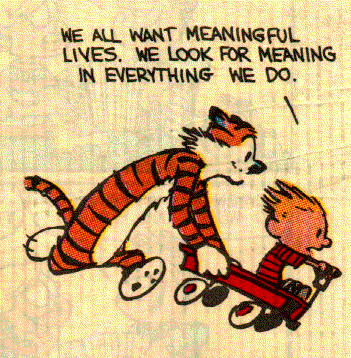
My earlier post focused on the fact that Sisyphus is never finished with his work--a condition I identified with, and still do. But today I am concerned, like Alfie, with meaning--with "What's it All About?"With the seeming futility of our hero's task. And of human existence in general.
I am given to understand that these questions I am pondering are often part of grieving when we lose someone close to us. Tomorrow is the third anniversary of my father's death, an occurrence I am taking my own sweet time in coming to terms with. A troubling voice inside my head has been whispering "What's the point?" for a while now.
I take comfort and instruction from Ellen Silverstein, songwriter and creativity coach, as she is quoted by Maisel (herself quoting Gandhi):
Gandhi said,"Whatever you do will be insignificant, but it is very important that you do it." I try to remember this crucial idea whenever I'm beset by the "Why bother?" blues, when I hear that whiny song in my head that says, "Who cares? What's the point of trying? The last thing the world needs is yet another unnoticed book/song/poem/painting. What difference does it make?"
Well, it makes a huge difference to me. [emphasis mine]
Silverstein goes on to speak of hearing from a stranger who was inspired by a story Silverstein wrote to re-establish contact with his estranged son. This reminds me that none of us know what part we may play in the lives of others and in the world, but that it is not right--according to the ethics that are an essential component of the meaning I am coming to recognize--to withhold our energies, our voice, our talent, our unique contribution.
For now, I see only the silhouette of what my life might mean. But I know I want it to mean something. And that it is up to me to figure it out. And to live--and to write--as if it matters.
According to Eric Maisel, Ph.D., author of Van Gogh's Blues: The Creative Person's Path Through Depression, meaning is at the heart of the depression experienced by most creative people. For those who think too much, and know too much, like many of us in the postmodern era, meaning is problematic. We are not content to live our lives within the confines of traditional patterns.
As Dr. Maisel maintains,
. . . virtually 100 percent of creative people will suffer from episodes of depression. Why virtually 100 percent? Because every creative person came out of the womb ready to interrogate life and determine for [him/]herself what life would mean, could mean, and should mean. [His/]Her gift or curse was that [he/]she was born ready to stubbornly doubt received wisdom and disbelieve that anyone but [he/]she was entitled to provide answers to [his/]her own meaning questions.
Despite having sworn off self-help books a couple of weeks back, I found myself drawn the past couple of days to revisiting this book I had begun reading earlier. Something about its warm deep blue dust jacket and Van Gogh-like cover illustration lured me, and I fell off the wagon. But it was a good fall, and maybe even a necessary one.
Dr. Maisel de-pathologizes the kind of funk I have been mired in since last fall; and I see that this period in which I am concluding much of the work and many of the roles that have occupied me requires a kind of spiritual realignment. I need to think again about what my life can mean, and what I want it to mean.
Maisel holds that
[i]n order for you to live an authentic, meaningful life, which is the principal remedy for the depression creative people experience, you must feel that 1) the plan of your life is meaningful, 2) the work you do is meaningful, and 3) the way you spend your time is meaningful. . . .[And] the ideal combination. . . is that your life plan feels meaningful to you and you actually live it; that the work you've chosen to do feels meaningful to you and you actually do it; and that your days, spent primarily doing your work and living your life plan, feel filled with meaning. To reach this goal, you must consciously hold the following four intentions:
To articulate a life plan that feels meaningful and to strive to live by that plan.
To articulate what constitutes worthy work and to accomplish that worthy work.
To articulate how the seconds, hours, weeks, and years that make up your life will be made to feel meaningful and to strive to actually make them feel meaningful.
To put the first three intentions into practice in a coordinated way. [emphasis mine]
This is a deceptively simple outline of how we can avoid the cart-before-the-horse problem I have alluded to before. Without some sense of what we are about, and why, endless crossing off--or failing to cross off--mindlessly listed items amounts to spinning our wheels. And even more seriously, we are left careening through our hours and days, spiritually rudderless. Which brings up all the fears inherent in our brief and ultimately doomed existence. And thus, depression, as our vulnerable amygdalae twitch and complain.
So I am being led back to the drawing board. To figure out where I'm going, before I continue my undirected journey.


 's eighth chapter--"Love It or Leave It: Finding Relevance in Work." My brief
  .
. , by Michael Burawoy. Burawoy's Marxist analysis argued that the "gaming" used by workers in which they competed with each other to "make out" in a piece rate pay structure, "playing all the angles," gave them the illusion of choice.
  , he notes that
  in this statement:
 . Not my cup of tea, but then I myself can get lost for hours following Facebook links to arcane discussions of Wisconsin state politics. My "work," as I define it, but not my "job."

 ) thoughts about meaning. (
 :
: ?"
?"


 Posts
Posts